

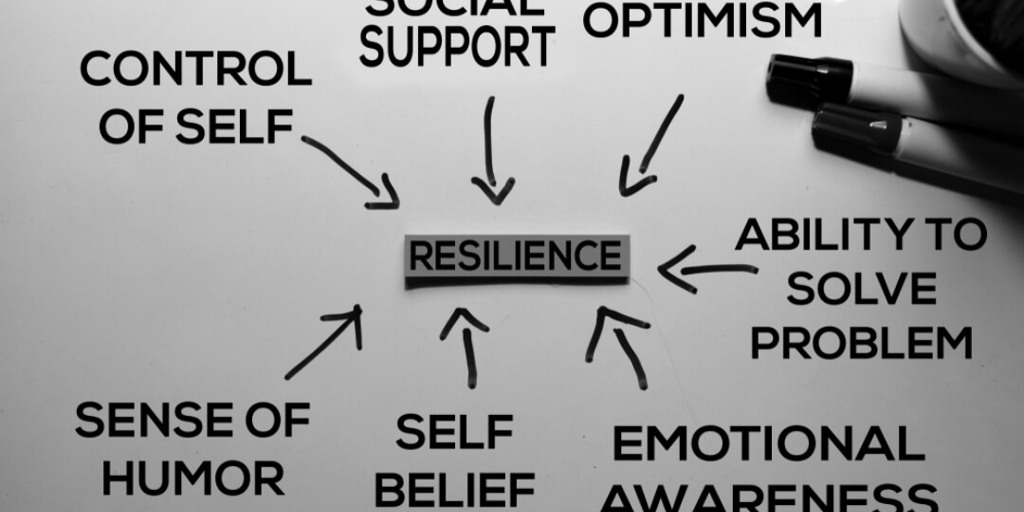
What do we do when the worst happens? It could be the death of a loved one. The loss of employment. Or even a devastating health diagnosis. People with resilience have the ability to come to terms with adversity and to recover. The good news is, while some people are predisposed to resilience, it is a set of skills that can be learned - and the tips in this guide will enable anyone to build their capacity for resilience.
Why is resilience so important?
Think back to any of your heroe's backstory. It could be an entrepreneur like Steve Jobs, an athlete like Serena Williams, or an intellectual like Albert Einstein. It doesn't matter whom you choose, there is one common thread in the histories of all great men and women: resilience in the face of adversity.
Everyone faces adversity at some point. Most people are a crisis away from losing their financial stability. Relationships very rarely pan out as planned. Parenting is a long journey filled with obstacles at every turn. Most people come to discover that their physical and mental health status was not as robust as they thought.
There is a reason why every culture has its version of the 'life is unfair' cliche.
Since adversity is inevitable, resilience just might be one of the most important mental traits to have. With resilience, we are not only able to recover from our lowest points, but we are also able to use these challenges as an opportunity to grow and become stronger. This is why resilience is a must-have trait for greatness.
7 Steps to build your resilience
The good news is that resilience is a skill that can be learned. Here are some tips on strengthening your ability to overcome adversity.
Develop a support network
You have a better chance of successfully dealing with adversity when you can get help from others. Your support network should include the people closest to you, those whom you can trust and in whom you can confide. This includes family members, friends, and even work colleagues.
Think of your support network as your first line of defense against the challenges that you will face. Your support group will provide you with encouragement and motivation when you are in the depths of despair due to a crisis. They can provide support in a number of ways, including advice and assistance on how you can get through a crisis. Just having someone you can confide in has been proven to be a valuable form of support.
More importantly, it is from your support network that you can get solutions due to their outside (and usually objective) perspective on the challenges that you are facing. In some cases, such solutions could come from their experiences with similar problems in the past. With a larger support group, you stand to benefit from a wider pool of experience and unique perspectives.
Take care of yourself
Self-care is something that we should always practice, but it becomes particularly important to take note of how you take care of yourself during a crisis. Basic self-care includes proper nutrition, adequate hydration, having a healthy sleep cycle, personal hygiene, regular exercise, and indulging in the hobbies or activities that make us happy. Incorporating these elements of self-care in your daily life will increase your self-esteem and overall happiness. This makes a person more impervious to the more devastating effects of adversity.
During a crisis, self-care is one of the first things that most people tend to neglect. Unfortunately, this creates a vicious cycle where the effects of self-neglect add to an individual's overall feelings of despair. Self-care is one of the first steps to take when you adopt a proactive strategy to recover from crises.
Accept that which is beyond your control
Challenges and crises can be brought about by factors that are either within our control or beyond our control. In most cases, it is usually an interesting combination of both types of factors. People who exhibit a higher capacity for resilience tend to have a better ability to accept factors and circumstances that are beyond their control.
It is important to note that this does not mean taking a defeatist attitude - it is all about adopting a realistic recovery action plan. For example, if your business fails during a period of recession, there is very little you can do to change the market status. You accept that the market forces are not ideal, and you adjust your goals and business strategies accordingly.
Understanding, and accepting, the issues that are beyond your control helps you in making plans that are achievable because they factor in these circumstances. It also puts us in a better position to deal with our challenges without succumbing to feelings of frustration and other negative emotional states.
Seek help
The field of personal development has grown tremendously over the past few decades. Most people can access a life coach, therapist, or mental health professionals with a quick internet search or a phone call. All of these professionals should be used as a resource when facing a major crisis. We have already touched upon the importance of developing a strong circle network that will act as a support group - but in some cases, they may be under-equipped to provide you with the assistance that you need. Try to assess your needs objectively to determine whether you need professional help - and what type of professional help you require. If you can't access or afford in-person help, you can try out online services that provide therapy, mentorship, and life-coaching advice.
Adopt a flexible mindset
Success often comes as a result of proper planning, but as most of us already know, very few plans pan out as intended - especially when it comes to long-term planning. While most of us understand the benefits of planning, fewer know how to adapt their plans once obstacles cause them to deviate. As resilience is the ability to recover from adversity, the fact that flexibility is a key component of resilience makes sense. As unforeseen events and circumstances get in the way of your plans, being flexible gives you the ability and creativity to factor in the changing circumstances and chart a new plan towards your goals. Of course, flexibility should be complemented by strong problem-solving skills for the best results.
Being proactive
Ranking all these tips is a difficult, and possibly impossible, task. That being said, being proactive has to be one of the most important mindsets to have if you are going to be resilient. You cannot be resilient if you expect all of your problems to disappear on their own. Being proactive is about assessing your situation, understanding the challenges that you are facing and, creating an actionable plan to improve your situation. Since having a proactive mindset is ultimately useless if you don't have an action plan, you need to work on your goal-setting skills. Effective goals have to follow the SMART goals model, meaning that they need to be Specific, Measurable, Achievable, Relevant, and Time-based. From these goals, an action plan can be developed based on the factors that are within your control - with the consideration of factors beyond your control. Without goals and an action plan, your efforts to better your situation may lack coherence, and the subsequent failure can add to your overall levels of stress, frustration, and despair.
Positive thinking
This is one of the more obvious, yet difficult, mentalities to adopt during a crisis. Nevertheless, failing to adopt positive thinking might jeopardize all the other strategies you have in place to recover from a major crisis. You need to view your situation from a position of optimism. This is a temporary setback, not your 'new normal.' Feelings of helplessness cause apathy, which leads to inaction. If you can't pick up your mood, seek help from your social network or even from mental health professionals. The importance of adopting a more positive outlook cannot be overemphasized. Along with a positive outlook, you also need to have belief in your ability to improve your situation. Recognize that recovery is a journey, and take small steps in the right direction. That is what resilience is all about.
Catastrophe, failure, and adversity are key components in every person's life story, which makes resilience one of the most important life skills to master. Luckily, it is a skill that can be learned. The best way to strengthen your capacity for resilience involves building a support network, self-care, accepting factors that are out of your control, and adopting a flexible mindset. It is also important to seek help when you need it and to adopt a positive outlook. More importantly, we need to be proactive when it comes to improving our circumstances in the wake of a crisis. With resilience, you will be better equipped to recover and even grow, in the face of adversity.
